Blog
Do Real Rolex Tick or Sweep? Authentication Guide

TL;DR: Yes, real Rolex watches do tick—but at 8 beats per second (28,800 VPH), creating a smooth sweep instead of an audible one-second tick-tock.
Bottom line: This guide is for buyers verifying authenticity before purchase and collectors debunking common myths. If you’re relying solely on sound to authenticate, you’re missing critical inspection steps.
Last updated: 2026-06-07, based on Rolex technical specifications, RepTime community teardown data, and ROLLEXTER’s decade of movement calibration experience across 50,000+ watches.
Key Takeaways
- Authentic Rolex movements beat at 28,800 vibrations per hour, producing 8 micro-ticks per second that blur into a near-silent sweep
- The myth “Rolex doesn’t tick” originated when 90% of counterfeits were cheap quartz watches that ticked once per second
- Modern high-grade replicas using cloned VS3135 or Clean Factory movements can replicate the sweep sound convincingly
- The vintage Rolex Oysterquartz (1977–2001) is the only legitimate Rolex model that produces an audible one-second tick
- Sound inspection is a useful first filter but must be combined with movement examination, weight verification, and serial authentication
What Is a Rolex “Sweep” and How Does It Work?
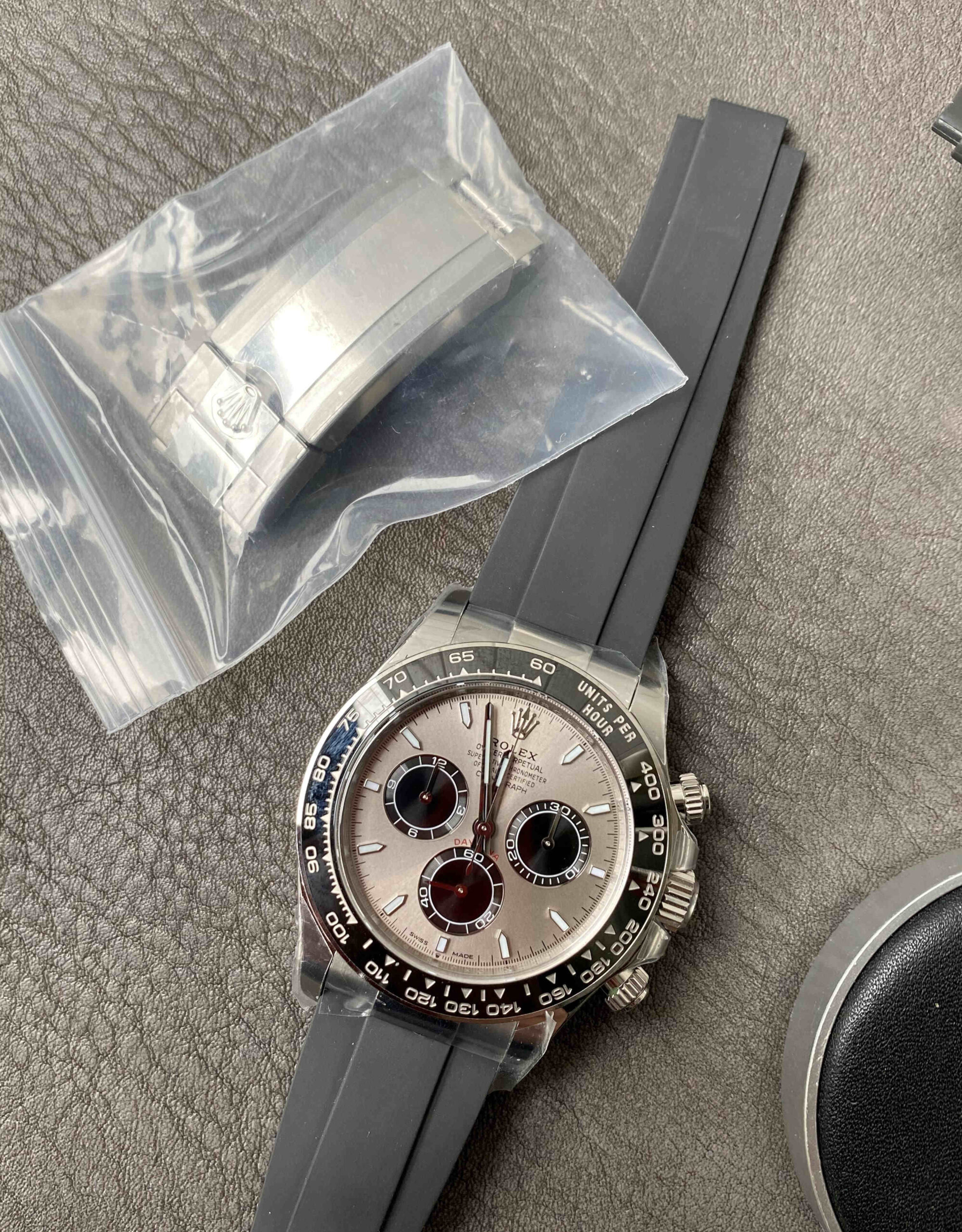
A Rolex sweep is the smooth, nearly imperceptible motion of the seconds hand across the dial, powered by a mechanical movement oscillating at 8 hertz. Unlike a quartz watch, which advances its seconds hand in discrete, audible one-second jumps, a genuine Rolex’s mechanical escapement releases energy in rapid micro-pulses.
All modern Rolex watches—Submariner, Datejust, Daytona, GMT-Master II—are powered by automatic or manual-winding mechanical movements calibrated to beat at 28,800 vibrations per hour (VPH), or 8 beats per second. The escapement consists of two pallets that alternately catch and release a dented escape wheel. Each cycle produces a microscopic “tick,” but because these occur 8 times per second, the human ear perceives them as a continuous, barely audible hum rather than distinct ticks.
When you hold a gen Rolex to your ear, you should hear a soft, continuous “tick-tick-tick” that blurs into an almost silent whisper—not the loud, mechanical “tick-tock” of a quartz watch or low-grade replica. This high beat rate defines Rolex’s precision standard. Cheaper mechanical movements beat at only 2.5 or 4 hertz, producing slower, more audible ticks. The faster oscillation in genuine Rolex calibres (such as the 3135, 3235, and 4130) allows the watch to regulate power more evenly, resist shocks better, and maintain superior accuracy.
Real Rolex vs. Fake Rolex: Ticking and Sound Comparison
| Feature | Authentic Rolex | Budget Counterfeit | High-Grade Replica |
|---|---|---|---|
| Beat Rate | 28,800 VPH (8 Hz) | 2,800–4,800 VPH (quartz or cheap automatic) | 28,800 VPH (if using cloned movement) |
| Audible Sound | Soft, continuous hum; barely perceptible | Loud, distinct “tick-tock” (quartz) or slow mechanical ticking | Soft hum (if movement is quality clone); may differ subtly |
| Seconds-Hand Motion | Smooth sweep across dial | Jerky, one-second jumps (quartz); slow mechanical tick | Smooth sweep (if using quality clone movement) |
| Escapement Quality | Precision-engineered Swiss calibre | Poorly finished, generic components | Attempts precision; may lack fine details |
| Price Range | $6,000–$15,000+ (retail) | $50–$300 | $300–$800+ |
Decision Rule: Sound is a useful first-pass authentication tool, but it should never be your sole verification method. Budget counterfeits are easily identified by their loud quartz tick or slow mechanical ticking. However, modern high-grade replicas using cloned movements can replicate the sweep sound convincingly. Always combine sound assessment with case inspection, dial printing, bezel quality, weight, and movement examination by a qualified watchmaker.
Why the Myth “Rolex Watches Don’t Tick” Persists
1. The Quartz Counterfeit Flood (1980s–2000s)
For decades, the counterfeit Rolex market was dominated by cheap quartz movements imported from Asia. These fakes ticked loudly once per second—a dead giveaway of inauthenticity. When collectors held a real Rolex next to a fake quartz, the contrast was stark. This led to the shorthand rule: “Real Rolex = no tick; Fake Rolex = obvious tick.” The rule worked because 90% of fakes at that time were indeed quartz.
2. Terminology Confusion: “Tick” vs. “Sweep”
The word “tick” is ambiguous. Technically, all mechanical watches tick (they oscillate). However, in casual language, “tick” refers to the audible, one-second-per-beat sound of a quartz watch. When enthusiasts said “Rolex doesn’t tick,” they meant “Rolex doesn’t produce a loud, audible one-second tick like a quartz watch.”
3. Internet Forums and Oversimplification
Early watch forums and eBay authentication guides simplified the rule into a binary: “Rolex = sweep, no tick; fake = tick.” This rule was easy to remember and often worked as a quick filter. Yet the simplified rule persists in online communities despite the complexity of modern-day fakery.
How to Authenticate a Rolex Using Sound and Movement Inspection
The Sound Test – What to Listen For
Hold the watch to your ear in a quiet environment. A genuine Rolex produces a soft, continuous, almost imperceptible hum—not a loud “tick-tock.” If you hear a loud, distinct tick-tock or a slow mechanical ticking, the watch is almost certainly a cheap quartz fake or a low-grade replica. High-grade replicas using cloned movements may pass this test, so proceed to the next steps.
Movement Inspection Under Magnification
Request to view the movement (this requires opening the caseback, which should only be done by a qualified watchmaker). Examine the movement under 10x magnification. Authentic Rolex movements display precise, laser-engraved text (calibre number, “Swiss Made,” jewel count), perfectly finished bridges with no rough edges or casting defects, clean symmetrical rotor engravings, and high-quality metal plating and polishing.
Verify Movement Markers and Specifications
Check for Calibre Number (Rolex uses specific calibres: 3135, 3235, 2836). Verify the number matches the watch model. Look for “Swiss Made” Marking—all modern Rolex movements are Swiss-made; this must be clearly engraved. Confirm Jewel Count (typically 21, 25, or 31 jewels). The movement should feature Rolex’s crown emblem.
Weight and Case Construction
Authentic Rolex watches are surprisingly heavy due to 904L stainless steel or solid gold construction. Compare the weight to known specifications. Budget fakes often use cheap alloys that feel lighter. Genuine 904L steel—the same corrosion-resistant alloy Rolex developed for marine applications—adds 8-12% more weight than standard 316L steel used in budget replicas.
Professional Third-Party Authentication
Never rely on sound alone. Consult a certified watchmaker or an authorized Rolex dealer for professional authentication. They can inspect the movement, verify serial numbers, test water resistance, and assess dial printing quality—factors that sound inspection cannot reveal.
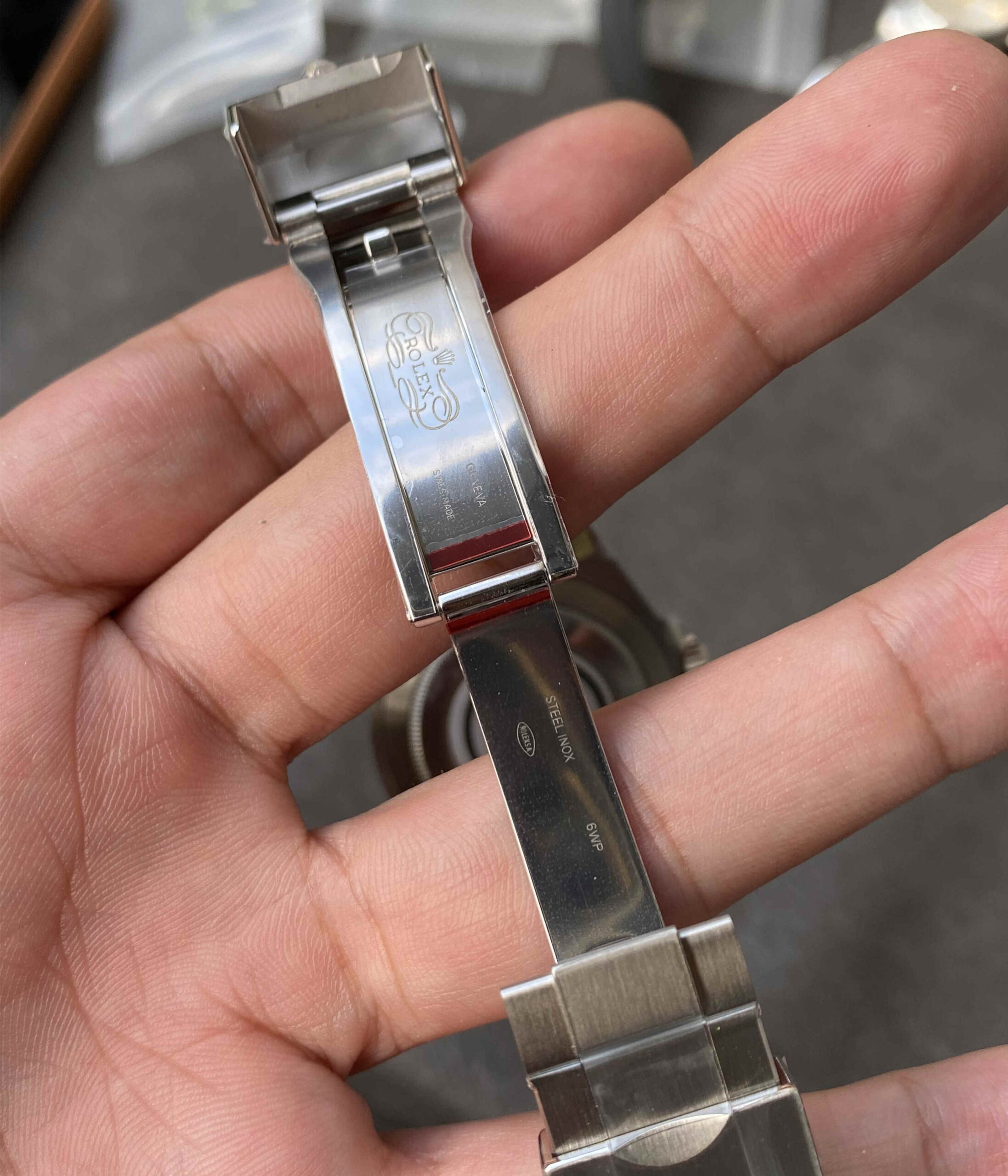
Rolex Calibre 3135 vs. Modern Clones: Beat Rate and Movement Quality
Rolex Calibre 3135 Specifications:
- 28,800 VPH (8 beats per second) — The standard oscillation rate for all modern Rolex automatic movements
- ±2 seconds per day accuracy — Certified COSC chronometer standard; real Rolex watches typically perform within this range
- 31 jewels — The movement contains 31 precisely cut synthetic rubies that reduce friction in critical pivot points
- 48-hour power reserve — A fully wound mainspring stores enough energy to power the watch for approximately 48 hours without winding
- Parachrom hairspring — Rolex’s proprietary blue alloy hairspring is paramagnetic (resistant to magnetic fields) and more shock-resistant than traditional steel hairsprings
High-Grade Clone Movement Performance:
- 28,800 VPH claimed — Modern clones attempt to match the beat rate, but consistency varies by factory batch
- ±5 to ±10 seconds per day accuracy — Clone movements typically achieve less precision than authentic Rolex calibres
- Variable jewel count — Some clones use 21 or 25 jewels instead of the authentic 31, reducing durability and accuracy
- 40–45 hour power reserve — Clone movements often fall short of the 48-hour standard due to less efficient mainspring design
FAQ
Q1: Do real Rolex watches tick at all?
Yes. Real Rolex watches tick 8 times per second (28,800 VPH), creating a smooth sweep motion. The confusion stems from comparing mechanical Rolex movements to quartz watches that tick once per second. The high-frequency oscillation produces a nearly silent, continuous hum rather than an audible “tick-tock.”
Q2: Can I tell if a Rolex is real just by listening to it?
Sound is a useful initial filter but not definitive. A loud, one-second tick indicates a quartz fake. A soft, high-frequency sweep suggests authenticity or a high-grade clone. However, modern replicas can replicate the sound convincingly. Always combine sound assessment with case inspection, movement examination, weight verification, and professional authentication.
Q3: Is the Rolex Oysterquartz an exception?
Yes. The Rolex Oysterquartz (produced 1977–2001) is Rolex’s only quartz model and does produce a distinct one-second tick. It is a legitimate Rolex product, not a counterfeit. If you encounter a vintage Oysterquartz with an audible tick, this is expected and does not indicate a fake.
Q4: Can high-grade replicas replicate the 8-beat sweep perfectly?
High-grade replicas using cloned movements (such as the VS3135 or Clean Factory calibres) can produce a sweep that is nearly indistinguishable from authentic Rolex movements to the untrained ear. However, subtle differences in escapement precision, jewel count, and long-term accuracy often emerge after weeks of wear. Professional movement inspection remains the most reliable authentication method.
Q5: What should I do if I suspect my Rolex is counterfeit?
Contact an authorized Rolex dealer or a certified independent watchmaker for professional authentication. They can perform movement inspection, water-resistance testing, dial printing analysis, and serial number verification. Do not attempt to open the caseback yourself, as this can damage the watch and void any warranty.
Sources
- Fratello Watches: Rolex Myth Busting #3 – Only Fake Rolex Watches Tick
- SwissWatchExpo: How to Spot a Fake Rolex
- G&G Timepieces: Do Rolex Watches Tick or Sweep?
Written by Tianhao Zheng (Luxury Watch Reverse Engineering, Swiss Clone Movement Calibration (Calibre 3135/3235/4130), Metallurgical Grading (904L vs 316L Stainless Steel), Horological Authenticity & Quality Control Auditing). Last reviewed 2026-06-07.